Following years of relative geopolitical isolation, Pakistan has achieved a remarkable diplomatic resurgence, positioning itself as an indispensable mediator in the volatile Middle East. This shift marks a transition from a submissive foreign policy to a pragmatic, multipolar strategy of strategic realism. Rather than aligning strictly with a single superpower, Islamabad has maintained parallel, constructive networks with China, the United States, and regional actors such as Iran. Under President Donald Trump’s administration, Pakistan executed a rapid pivot towards Washington, enhancing cooperation on regional stability. Concurrently, Islamabad leveraged its deep ties with Tehran to facilitate critical back-channel communication. From a strategic perspective, this transition represents a sophisticated deployment of geo-economics and multipolar hedging.
Mediating the 2026 United States–Iran War
When the United States–Iran War erupted in early 2026, Pakistan emerged as the primary back-channel mediator between the two adversaries. Backed by Qatar, Saudi Arabia, Turkiye, and China, Pakistan brokered a fragile ceasefire that came into effect on 8 April 2026. When negotiations in Islamabad threatened to collapse on 15 April, Field Marshal Munir travelled directly to Tehran in full military attire to persuade Iranian commanders to return to the negotiating table.
To maintain the momentum, Pakistan facilitated critical de-escalation steps, including coordinating the evacuation of 22 crew members from the captured Iranian vessel MV Touska back to Iran on 4 May. Whilst the ceasefire remains highly volatile and faces frequent threats of collapse over regional conflicts, including Israeli offensives in Lebanon, Pakistan’s back-channel remains the active core of de-escalation. On 29 May 2026, Deputy Prime Minister Ishaq Dar met with US Secretary of State Marco Rubio in Washington to negotiate a 60-day ceasefire extension. This was followed by a direct telephone call on 1 June 2026 between Dar and Egyptian Foreign Minister Badr Abdelatty to secure broader Arab support for the diplomatic track, symbolising the pan-regional efforts Pakistan is leading.
This pan-regional framework is structured around keeping vital maritime lanes open and managing conflicting red lines, such as Washington’s demands for uranium dilution and Tehran’s insistence on comprehensive sanctions relief. This mediation role creates significant geopolitical friction elsewhere, much to Pakistan’s benefit. In particular, the Trump administration’s open favouritism towards FM Asim Munir has deeply alienated New Delhi. Indian policy circles continue to express growing alarm over the US decision to elevate Pakistan as a primary Middle East intermediary. Critics argue that the West’s rapid diplomatic rehabilitation of Islamabad ignores decades of cross-border security concerns, risking long-term strategic coherence in the Indo-Pacific.
The European Union’s Endorsement: Kallas’s Historic Visit
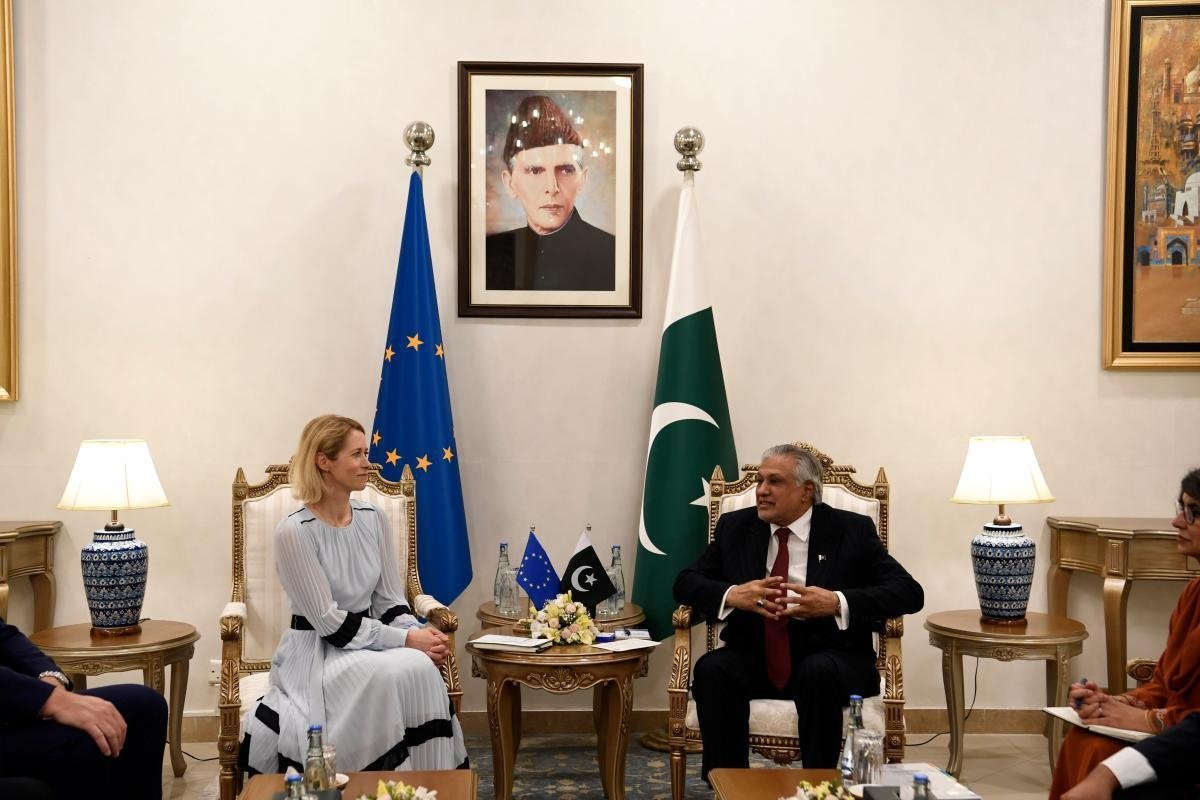
On 1 June 2026, the European Union’s High Representative for Foreign Affairs and Security Policy, Kaja Kallas, travelled to Islamabad for the 8th EU-Pakistan Strategic Dialogue. During her visit, Kallas met with Deputy Prime Minister Ishaq Dar as well as President Asif Ali Zardari and Prime Minister Shehbaz Sharif.
Kallas publicly lauded Pakistan’s diplomacy, stating that Islamabad’s mediation between the US and Iran “helped to prevent a return to full-blown war on several occasions,” noting that these efforts are “much recognised and appreciated across Europe.” She expressed the EU’s readiness to play a concrete role in making any eventual peace agreement durable through maritime security operations or economic incentives.
Beyond regional security, Kallas highlighted the depth of the EU-Pakistan economic partnership, noting that the EU remains Pakistan’s largest export destination, larger than China and the United States combined. On the recent regional border tensions between Pakistan and Afghanistan, Kallas recognised Pakistan’s right to self-defence under international law but urged that dialogue, rather than airstrikes, remain the primary means of preventing further instability. Furthermore, Kallas endorsed Pakistan’s stance on Indian Illegally Occupied Jammu and Kashmir, acknowledging Pakistan’s legitimacy as a party to the conflict, contrary to India’s claims.
Prime Minister Sharif thanked Kallas and the EU leadership for their strong support of Pakistan’s peace efforts in the Gulf, specifically highlighting the crucial role played by Deputy Prime Minister Dar and Field Marshal Munir in stabilising the region.
Strategic Outlook
Pakistan’s diplomatic rise in 2026 represents a calculated mastery of strategic realism. By positioning itself as an indispensable bridge between Washington, Tehran, Beijing, and Brussels, Islamabad has converted its geopolitical leverage into newfound global authority. Whilst the peace process remains highly fragile, Pakistan has demonstrated how a middle power can effectively navigate and shape international security in a multipolar world, whilst simultaneously developing its own diplomatic footprint towards becoming a regional power.
To sustain this trajectory, policymakers in Islamabad must address critical structural vulnerabilities. The country’s diplomatic triumphs are currently decoupled from its internal economic reality, which remains highly dependent on IMF-mandated structural reforms and vulnerable to external energy shocks. Ultimately, Pakistan’s rise as a regional power will depend on whether its dual-engine executive can translate short-term diplomatic arbitrage into simultaneous long-term domestic economic stability.