Maritime chokepoints are the narrow arteries through which the lifeblood of the global economy flows. These critical passages, whether natural straits or man-made canals, handle a disproportionate share of global trade, energy shipments, and strategic naval movement. While often overlooked in everyday discourse, their importance becomes starkly visible when disruption occurs. Events such as the 2021 Ever Given grounding in the Suez Canal and the 2026 conflict in the Strait of Hormuz illustrate just how fragile and interconnected global supply chains truly are.
A Global Network of Chokepoints
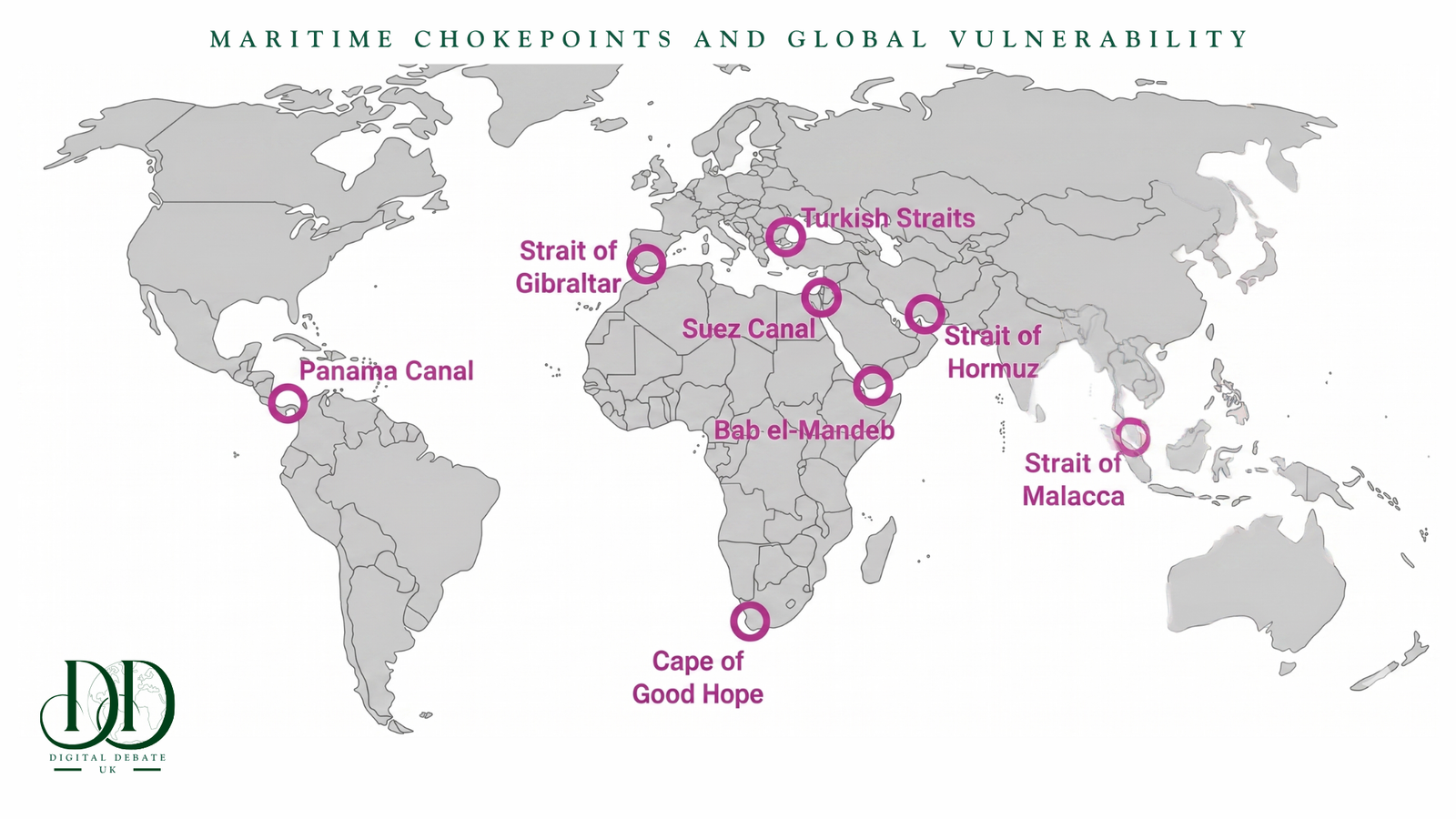
The Strait of Hormuz is just one of several critical maritime chokepoints that underpin global commerce. Eight primary chokepoints are widely recognised for their strategic importance:
- The Panama Canal
- The Strait of Gibraltar
- The Cape of Good Hope
- The Bosporus
- The Suez Canal
- The Bab el-Mandeb
- The Strait of Hormuz
- The Strait of Malacca
Together, these chokepoints form an interconnected system that supports the continuous flow of goods and energy. Disruption in any one of them can ripple outward, but simultaneous disruptions could trigger systemic breakdowns.
The Strait of Hormuz: From Strategic Asset to War Zone (2026)
If the Suez blockage demonstrated the risks of accidental disruption, the 2026 crisis in the Strait of Hormuz revealed the far greater danger posed by geopolitical conflict. The Strait of Hormuz is the world’s most critical energy chokepoint. Under normal conditions, around one-fifth of global oil consumption and significant volumes of LNG pass through this narrow passage daily.
In 2026, escalating tensions between Iran and the United States erupted into open conflict. Following US airstrikes on Iran, Iran responded by effectively closing the strait. Naval mines were deployed, commercial vessels were seized or attacked, and warnings were issued to international shipping.
The United States, in turn, launched operations to reopen the passage, including naval escorts and mine-clearing missions. The result was a “dual blockade,” with both sides restricting movement in one of the world’s most vital waterways.
Shipping traffic collapsed. Tanker flows dropped dramatically, energy prices surged, and insurance premiums skyrocketed. Unlike the Suez Canal, there is no viable large-scale alternative route for Persian Gulf exports. Pipelines can offset some capacity, but they cannot replace maritime flows. This made the Hormuz crisis not just an example of uniquely severe disruption, but a strategic shutdown of global energy supply.
The Suez Canal: A Six-Day Crisis with Global Consequences
On 23 March 2021, the ultra-large container ship Ever Given ran aground in the Suez Canal, blocking traffic in both directions. Though the vessel was stuck for only six days, the impact reverberated across the global economy for weeks.
The Suez Canal is far more than a regional waterway. The majority of oil transported by sea passes through it, being the fastest crossing between the Atlantic Ocean and the Indian Ocean, directly connecting the Mediterranean Sea to the Red Sea. In practical terms, it links Europe and Asia into a single continuous trade network. On average, 40 to 50 vessels transit the canal every day, carrying everything from consumer goods to oil and liquefied natural gas.
The canal’s value lies in the distance and time it saves. It provides a direct shortcut that allows vessels to travel between Europe and Asia without navigating around the African continent, cutting transit time by approximately 10 to 14 days compared to the lengthy voyage around the Cape of Good Hope.
For container shipping, this difference is decisive. Modern shipping operates on tightly scheduled loops, and delays in one segment can disrupt entire global networks. While some tankers occasionally bypass the canal to avoid tolls, container ships, which are bound to strict timetables, rarely have that option. The Suez Canal is not just the fastest route; it is the backbone of Asia–Europe trade.
The Ever Given incident exposed how even a temporary blockage in a single chokepoint can halt billions of dollars in trade, delay hundreds of vessels, and create congestion that takes weeks to unwind.
The Panama Canal and Global Shipping Loops
The Panama Canal plays a role similar to Suez in the Western Hemisphere. Its expansion has enabled larger vessels to transit, making it a critical link between Asia and the eastern United States.
In combination with the Suez Canal, it allows shipping companies to design global loops connecting Asia, Europe, and North America. This interconnected system maximises efficiency but also increases vulnerability. If both canals were disrupted simultaneously, global trade would face unprecedented delays and costs, forcing ships onto far longer alternative routes.
Bab el-Mandeb: The Gate of Tears
The Bab el-Mandeb serves as the southern gateway to the Suez Canal, connecting the Red Sea to the Gulf of Aden. Its strategic importance is amplified by its location in a volatile region. Conflict in Yemen, instability in Djibouti, and tensions in Ethiopia all contribute to elevated risk. While a full closure is unlikely, the threat of piracy, missile attacks, or drone strikes remains significant. A disruption here, especially in combination with issues in the Suez Canal, could severely impact Europe–Asia trade routes.
The Strait of Malacca and the South China Sea
The Strait of Malacca is one of the busiest shipping lanes in the world, with around 100,000 vessels transiting annually. It is the primary route connecting the Indian Ocean to the Pacific, making it essential for trade between Europe, the Middle East, and East Asia.
While piracy has historically been a concern, modern risks include congestion and navigational hazards. The narrowness of the strait increases the likelihood of collisions or groundings, any of which could disrupt traffic. Beyond Malacca lies the South China Sea, a vast but highly contested maritime space. Multiple nations, including China, Vietnam, and the Philippines, have competing territorial claims.
China’s construction of artificial islands and military installations has heightened tensions, while the United States continues to advocate for freedom of navigation. Any escalation could disrupt one of the world’s most important trade corridors.
Other Strategic Gateways
The Strait of Gibraltar serves as the gateway between the Atlantic Ocean and the Mediterranean, while the Bosphorus connects the Black Sea to global markets. Both are vital for regional trade and carry significant strategic military importance. Control over these passages has been contested for centuries, and they remain geopolitically sensitive.
The Risk of Cascading Failures
The most important lesson from recent events is not just that chokepoints are vulnerable, but that the global order depends on them all functioning simultaneously.
The Ever Given blockage was an isolated incident. The Hormuz crisis is a regional conflict. But the scale of global economic disruption becomes incalculable if multiple chokepoints fail at once. A scenario in which the Suez Canal is blocked, the Bab el-Mandeb becomes unsafe, and the Strait of Hormuz is closed due to conflict represents a matter of serious concern for global economic planners. In such a case, the primary trade route between Europe and Asia would collapse entirely causing ships to be rerouted around Africa, dramatically increasing transit times, costs, and supply shortages.
Modern supply chains are optimised for efficiency, not resilience. Just-in-time logistics, minimal inventory buffers, and tightly scheduled shipping loops leave little room for error. When chokepoints fail, the consequences are amplified across the entire system.
Geopolitical conflicts pose a great and sustained threat. As global trade continues to grow, the challenge will be balancing efficiency with resilience. Diversifying routes, investing in infrastructure, and enhancing international cooperation will be essential to safeguarding these critical passages. Because in the end, control over a few narrow waterways can shape the flow of global commerce , and the stability of the world itself.