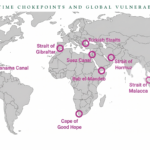

For over a decade, the strategic discourse surrounding the Indian Ocean Region (IOR) has been heavily influenced by the narrative of India aspiring to act as a “net security provider”. However, the recent escalation of maritime incidents in the Gulf of Oman and the broader Arabian Sea has cast a significant shadow over this proposition. Reports detailing the US military’s disabling of the commercial oil tanker M/T Jalveer and the alleged targeting of the Iranian naval vessel IRIS Dena underscore a growing volatility in these critical waters. These events suggest that the current security architecture, increasingly underpinned by the US–India strategic partnership, may be generating friction rather than fostering the stability it promises.
The core of the issue lies in the fundamental divergence of strategic priorities. The integration of an extra-regional superpower into the maritime security framework of South and West Asia inherently introduces global geopolitical calculations into local waters. While Washington frequently views the IOR through the lens of great power competition and containment strategies, such as enforcing unilateral blockades and isolating Tehran, these objectives do not inherently align with the economic and security imperatives of regional littoral states. Consequently, the facilitation of a deeper US naval footprint by regional actors risks transforming the Indian Ocean into a theatre for proxy confrontations, thereby undermining the safe passage of global trade.
Furthermore, the reported targeting of commercial vessels with civilian crews exposes the tangible, human risks of this militarised environment. When regional actors tether their maritime security to foreign powers, they inadvertently import those powers’ external conflicts. The ensuing militarisation not only destabilises vital maritime choke points but also erodes the strategic autonomy of all South and West Asian states. The assumption that an external hegemon can neatly manage the complex, localised security dilemmas of the Indian Ocean is increasingly being proven false. True regional resilience requires cooperative mechanisms, not the outsourcing of defence to powers whose presence is dictated by external rivalries.
This dynamic of external pressure and local vulnerability is further complicated by the adaptive strategies of other regional actors attempting to navigate the fallout. During the acute phase of the recent US–Iran hostilities, which saw transit through the Strait of Hormuz severely restricted, Pakistan emerged as a crucial diplomatic intermediary. In a notable development, Islamabad secured an agreement with Tehran explicitly permitting the safe passage of Pakistani-flagged commercial vessels through the choke point. Consequently, the Pakistani flag temporarily functioned as a rare shield for maritime trade in an otherwise paralysed corridor. While Pakistan’s diplomatic manoeuvring provided a vital, albeit limited, economic lifeline, the phenomenon illustrates a systemic failure: when international sea lanes are weaponised by great power rivalries, the burden of ensuring free passage is inequitably offloaded onto ad hoc, bilateral exemptions rather than being guaranteed by a cohesive regional security architecture.
Strategic Outlook
Looking ahead, the security environment in the Indian Ocean Region is poised to remain highly fragile unless there is a paradigm shift in how littoral states approach maritime governance. The continued reliance on extra-regional powers to underwrite security is proving counterproductive, as it prioritises global geopolitical manoeuvres over local stability. If the current trajectory persists, the IOR will increasingly suffer from the spillover effects of international conflicts, further diminishing the credibility of any single nation attempting to act as a regional guarantor. To mitigate these vulnerabilities, it is imperative for South and West Asian states to cultivate inclusive, region-led diplomatic and security frameworks that insulate vital maritime corridors from the disruptive currents of great power competition.