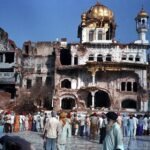
The Indian Army’s intervention at the Akal Takht and the broader Golden Temple grounds serves as a profound historical study of the immense tactical challenges and cascading long-term consequences that arise when state-led military maneuvers are conducted within deeply sensitive, sacred environments.
Operational Timeline
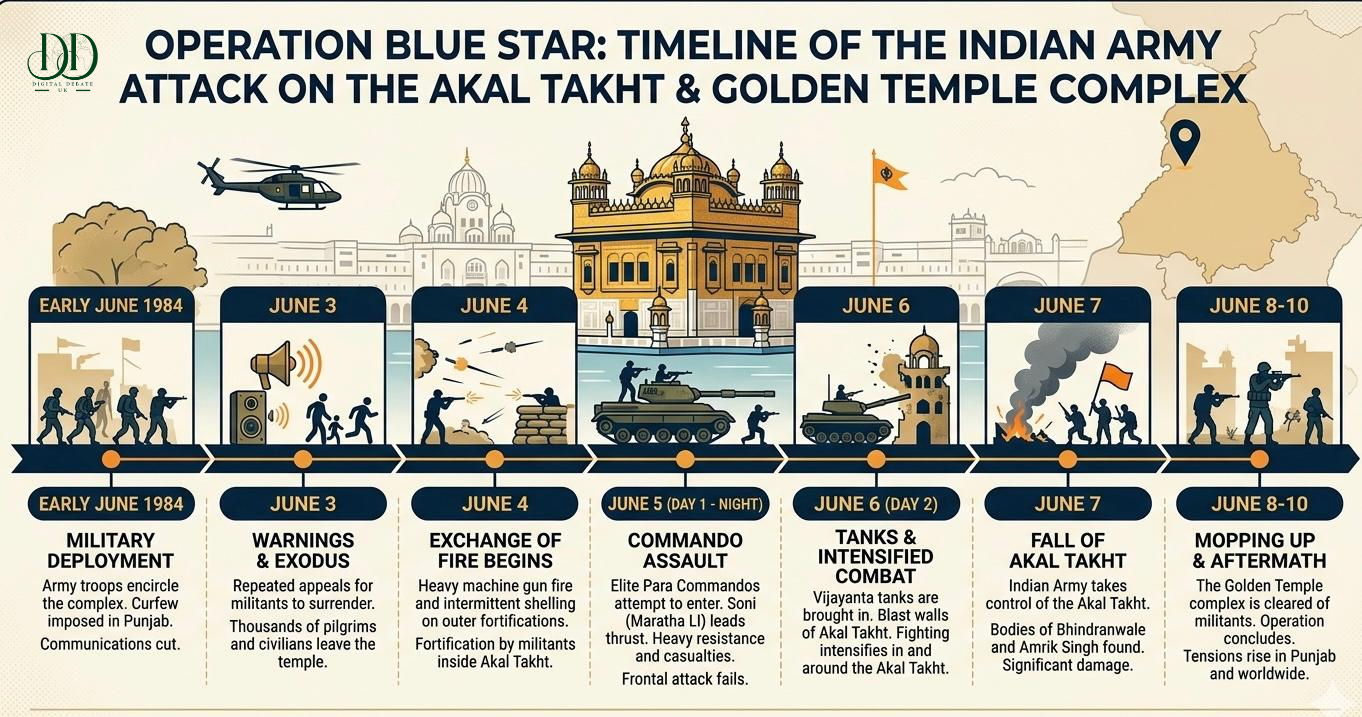
- Initial Staging (Early June 1984): The government initiated a total security lockdown, with military units completely cordoning off the temple perimeter. A region-wide curfew was enacted across Punjab, accompanied by a comprehensive blackout of all telecommunications to isolate the theater of operations.
- Evacuation Phase (June 3): Authorities broadcast repeated directives demanding that all militants surrender their positions. This window allowed a large-scale exodus of thousands of pilgrims and local civilians seeking to exit the complex before the situation further deteriorated.
- Outbreak of Hostilities (June 4): The conflict transitioned into active warfare as the army began striking the outer fortifications with artillery and sustained automatic weapon fire. Militants responded from within the Akal Takht, where they had heavily reinforced their defensive positions.
- Failed Breakthrough (June 5 Night): Elite Para Commando units, led by the Maratha Light Infantry, launched a high-risk frontal assault to breach the complex. This attempt was repelled by fierce defensive fire, leading to significant personnel losses for the attacking forces.
- Escalation and Heavy Armor (June 6): The engagement reached a critical turning point when the military authorized the use of Vijayanta tanks to overcome the resistance. Heavy bombardment breached the blast walls of the Akal Takht, precipitating intense, close-quarters combat inside and surrounding the structure.
- Securing the Site (June 7): Army forces finally established control over the Akal Takht. During the search of the site, which had sustained severe structural damage, the bodies of core insurgent leaders Jarnail Singh Bhindranwale and Amrik Singh were identified.
- Final Clearing and Aftermath (June 8–10): The mission moved into a mop-up phase, ensuring all remaining armed elements were removed from the Golden Temple premises. The operation’s conclusion triggered a sharp rise in regional volatility, creating long-standing socio-political repercussions both within Punjab and across the global Sikh diaspora.