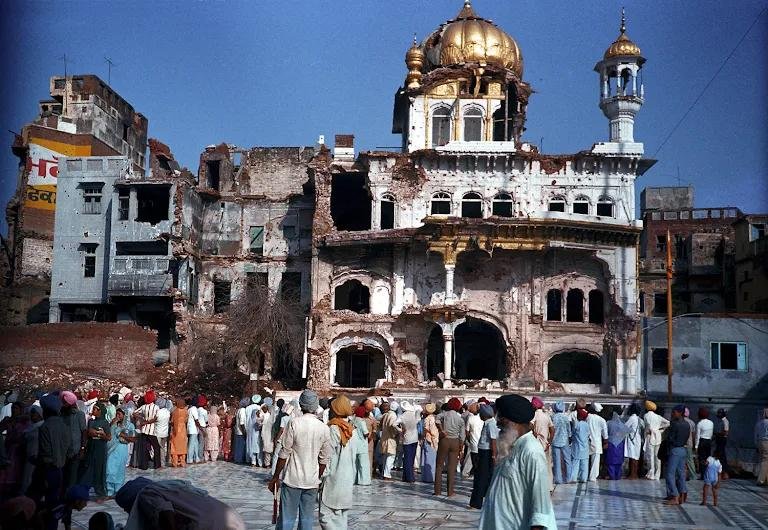
The June 1984 Indian military assault on the Sikh religion’s most sacred place of worship, the Golden Temple complex, Sri Harimandar Sahib and Akal Takht Sahib, stands as a monumental watershed in modern Sikh and Indian history. This historical event exposed a profound rift between state-mandated narrative and collective trauma. The Indian government classified the assault as “Operation Bluestar,” framed as a “necessary measure” to “stabilise Punjab and suppress terrorism.” In stark contrast, the Sikh community remembers the assault as a Ghallughara (massacre), a term deeply embedded in the Sikh psyche, signifying a large-scale massacre which amounted to a genocide.
The historical context, military logistics, human toll, and subsequent efforts to reveal the truth are critical to understanding this event, as exemplified by the preservation of “Bhan Singh’s List,” the foundational document that challenges state claims and illuminates the realities of the 1984 tragedy.
The Clash of Narratives: Operation Bluestar vs. Ghallughara
On 10 July 1984, the Government of India released its official White Paper on the Punjab Agitation. The document claimed the military intervention was required for “controlling extremist, terrorist and communal violence in Punjab, providing security to the people and restoring normalcy.” It argued that extremist elements sought to destroy the common culture of Punjab and fragment its society.
However, independent commentators, historians, and legal experts sharply critiqued the government’s presentation:
- A.G. Noorani, a prominent lawyer and historian, remarked in A White Paper on Black Record that “the White Paper does little to repair the government’s impaired credibility, everything to destroy it.”
- Madhu Danadvate, an opposition Member of Parliament, stated in the Lok Sabha that the document was merely a “white cover to conceal all the failures of the government to bring about settlement of the Punjab problem.”
- The Citizens for Democracy, in their September 1985 publication Report to the Nation: Oppression in Punjab (which was subsequently banned by the Indian government), noted the immense factual gap between official radio, television, and press broadcasts and the firsthand accounts of survivors.
Military Logistics and Leadership
The Indian military operation was vast and structured into three primary components: clearing the Golden Temple complex, clearing other Gurdwaras across Punjab, and sealing the international border.
Commands and Divisions Involved
The Chief of Army Staff (COAS), General Arun Shridhar Vaidya, assigned the operation to the Western Command, headquartered at Chandimandir and led by General Officer Commanding-in-Chief (GOC-in-Chief) General Krishnaswamy Sundarji. The actual tactical planning was managed by the Chief of Staff (COS) of Western Command, Lieutenant General Ranjit Singh Dayal.
The primary assault force was drawn from the 9 Infantry Division (based in Meerut), commanded by Major General Kuldip Singh Brar. This division was supported by the 15 Infantry Division based in Amritsar. Specific units deployed included:
- 9 Kumaon, 10 Guards, 12 Bihar, and 26 Madras (comprising the 350 Infantry Brigade).
- 1 Parachute Regiment and the Special Frontier Force (SFF) acting as commando support.
- Armoured support from the 16 Cavalry, utilising Armoured Personnel Carriers (APCs), BMP mechanised vehicles, and main battle tanks.
- Paramilitary support from the Border Security Force (BSF) and the Central Reserve Police Force (CRPF).
Tactical Phases
The internal operations within the complex were divided into distinct phases:
- Surrounding Clearance: Neutralising militant positions in the buildings immediately adjacent to the complex.
- Operation SHOPS: Eliminating or capturing resistance inside the main temple compound.
- Operation METAL: A specialised commando operation intended to secure Harimandar Sahib by swimming across the sacred pool (sarovar).
- Operation FLATS: Subsequent mopping-up operations across the wider state of Punjab.
Critiques of the military execution came from within the armed forces itself. Major General Afsir Karim, a paratrooper and contemporary of Brar, characterised Operation Bluestar as a failure due to the total destruction of the Akal Takht before objectives were met, substantial collateral damage, and immense civilian casualties. General Shankar Roy Chowdhury, a subsequent Chief of Army Staff, later reflected that the operation was “totally unwarranted and a mistaken step,” driven primarily by “political considerations” in New Delhi.
The Disputed Casualty Figures
The exact human cost of the 60-hour battle, lasting from 4:00 AM on 4 June to 4:00 PM on 6 June, remains highly contested, with a vast discrepancy between official statistics and independent assessments. The official state figures published in the government’s White Paper claimed that 83 military troops were killed and 249 were wounded, whilst civilian and militant casualties were reported at 493 killed and 86 injured. However, independent journalistic and community records present a much higher toll.
Braham Chellaney, an Associated Press reporter who was the only foreign reporter to evade government-imposed censorship and stay in Amritsar during and immediately after Operation Bluestar, sent out early dispatches reporting that around 400 troops and approximately 780 members of sikh resistance force and civilians had been massacred. Chellaney also noted horrific details, such as several Sikhs being shot with their hands tied behind their backs. Over time, external observers estimated even larger numbers; Mark Tully of the BBC placed the civilian death toll at approximately 4,000, whilst Chand Joshi of The Hindustan Times estimated it to be closer to 5,000. Furthermore, in the SGPC White Paper authored by Gurdarshan Singh Dhillon, independent sources quoted civilian deaths ranging anywhere from 3,000 to 8,000. Independent and academic researchers generally project a minimum of 10,000 casualties, with internal Punjab police assessments cited by scholars reaching as high as 20,000.
Bhan Singh’s List: Direct Evidence of the Human Cost
Amidst these conflicting numbers, direct documentation provides crucial insight. A primary piece of evidence is a 120-page document known as “Bhan Singh’s List.”
Sardar Bhan Singh was the Secretary of the Shiromani Gurdwara Parbandhak Committee (SGPC) during the 1980s. He was deeply integrated into Sikh institutional life, serving as the General Secretary and President of the All India Sikh Students Federation and as a judge on the Sikh Gurdwara Judicial Tribunal.
Eyewitness Account and the Creation of the List
Bhan Singh was inside the Golden Temple complex when the assault began. Because 3 June coincided with the martyrdom day of Guru Arjan Sahib, thousands of innocent pilgrims were trapped inside the complex due to an unannounced curfew. Bhan Singh’s accounts describe the trauma and a complete lack of medical provisions, noting that the military blocked Red Cross personnel more than a kilometre away from the main entrance at Jallianwala Bagh.
Following his arrest on 6 June alongside Akali leaders Sant Harchand Singh Longowal and Gurcharan Singh Tohra, Bhan Singh committed himself to recording the names of the deceased. Written in the Gurmukhi script, his list meticulously documented 706 individuals, recording their names, fathers’ names, home addresses, ages, heirs, and attesting witnesses.
Preservation and Digitisation
Recognising the danger of state confiscation, Bhan Singh mailed the 120-page document to Dr Joyce Pettigrew in Belfast, Northern Ireland, in November 1985. Dr Pettigrew, a social anthropologist who spent over 40 years studying Punjab, preserved the document. Bhan Singh was assassinated on 25 July 1988.
In 2005, Dr Pettigrew entrusted the original list to Harinder Singh of the Sikh Research Institute (SikhRI). With her formal permission, the document was digitised and translated into English. On 3 June 2017, the complete record was made accessible to the public via a free online repository.
The preservation of Bhan Singh’s List underscores the ongoing challenge of documenting the 1984 massacre. It provides empirical evidence that challenges the low civilian casualty figures published in the Indian government’s White Paper. As Dr Pettigrew observed, the intervention appeared designed “not to eliminate a political figure or a political movement but to suppress the culture of a people.” Decades after the event, a comprehensive, globally recognised master list of all who perished does not yet exist. Unearthing historical records, digital preservation efforts, and data-driven dialogue remain vital for accurately honouring and remembering those who lost their lives.
Aisha Ghazi is a human rights lawyer, author, and documentary filmmaker dedicated to uncovering untold histories. Her work focuses on war and conflict, socio-psychological grounds dictating violence, refugee crisis, geopolitics and history. She is the director of iResist, a human rights platform that advocates human rights through documentary, and a Solicitor of the Supreme Court of England and Wales.