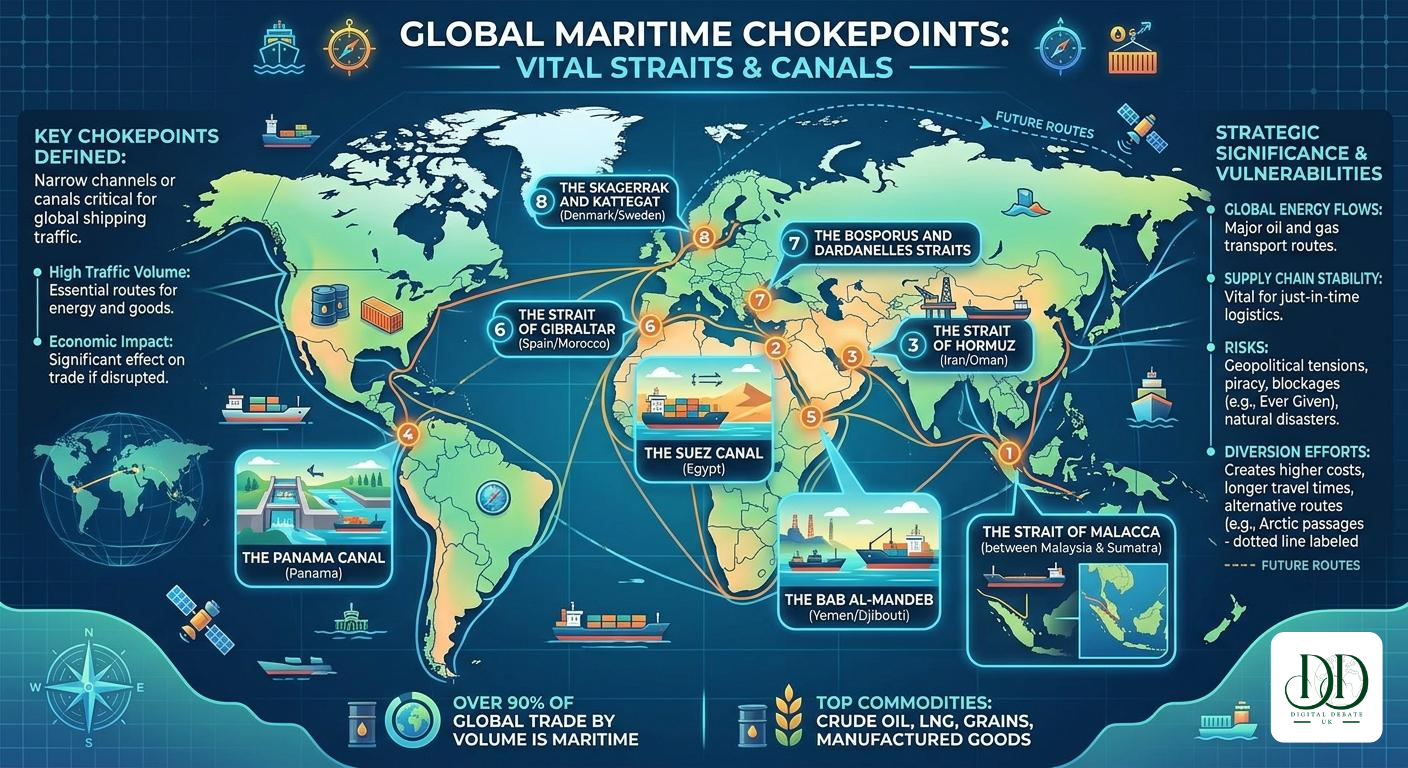
Over 90% of global trade by volume moves by sea, flowing through eight critical maritime chokepoints. A disruption to any one of them sends shockwaves through global supply chains.
The Eight Chokepoints
1. The Strait of Malacca (Malaysia/Sumatra)
- Volume: Over 94,000 vessel transits recorded in 2024, surpassing 100,000 in 2025. Handles approximately 29% of global maritime oil flows.
- Strategic Role: The primary route connecting the Indian Ocean to the Pacific, linking Europe, the Middle East, and East Asia.
- Risk: Congestion, navigational hazards, and piracy. A closure would cripple trade across the entire Indo-Pacific.
2. The Strait of Hormuz (Iran/Oman)
- Volume: Around 20 million barrels of oil and petroleum products transited daily in 2024 and 2025, equivalent to approximately one-fifth of global petroleum liquids consumption. Handles nearly 20% of global LNG trade.
- Strategic Role: The sole maritime export route for Persian Gulf energy producers including Iran, Iraq, Kuwait, and Qatar.
- Risk: No viable large-scale alternative route exists. Geopolitical conflict, as demonstrated in 2026, can effectively shut down global energy supply.
3. The Suez Canal (Egypt)
- Volume: At its 2023 peak, approximately 80 ships transited daily. Traffic collapsed by over 55% following Houthi attacks on Red Sea shipping from late 2023.
- Strategic Role: The fastest maritime crossing between Europe and Asia, saving vessels up to 14 days compared to routing around Africa.
- Risk: Regional instability at the Bab al-Mandeb directly throttles Suez traffic. The 2021 Ever Given grounding demonstrated the canal’s vulnerability to even accidental disruption.
4. The Panama Canal (Panama)
- Volume: Handles approximately 6% of global seaborne trade, with expanded locks enabling larger vessel classes.
- Strategic Role: The primary link between the Pacific and Atlantic Oceans, connecting Asia to the eastern United States.
- Risk: Drought-driven water shortages significantly reduced transits in 2023 and 2024, exposing a critical climate vulnerability.
5. The Bab al-Mandeb (Yemen/Djibouti)
- Volume: The southern gateway to the Suez Canal, connecting the Red Sea to the Gulf of Aden.
- Strategic Role: All vessels transiting between Europe and Asia via Suez must pass through this strait.
- Risk: Houthi missile and drone attacks since late 2023 have effectively forced the majority of Europe-Asia shipping to reroute around Africa, adding thousands of miles and significant cost.
6. The Strait of Gibraltar (Spain/Morocco)
- Volume: All maritime traffic entering or leaving the Mediterranean must pass through this 14-kilometre-wide passage.
- Strategic Role: Gateway between the Atlantic Ocean and the Mediterranean, serving southern Europe, North Africa, and the Middle East.
- Risk: Geopolitical sensitivity between Spain, Morocco, and the UK (over Gibraltar) creates a persistent diplomatic friction point alongside its maritime importance.
7. The Bosporus and Dardanelles (Turkey)
- Volume: The sole maritime exit from the Black Sea, carrying grain, oil, and goods from Russia, Ukraine, and the wider Black Sea region.
- Strategic Role: Connects Black Sea nations to global markets; has been a contested strategic asset for centuries.
- Risk: Turkey exercises sovereign control under the 1936 Montreux Convention, giving it the legal authority to restrict warship transit during conflict.
8. The Skagerrak and Kattegat (Denmark/Sweden)
- Volume: The northern European gateway connecting the North Sea to the Baltic Sea.
- Strategic Role: Critical for Scandinavian trade and the movement of goods to and from the Baltic states, Germany, Poland, and Russia.
- Risk: Heightened NATO-Russia tensions in the Baltic have elevated the strategic sensitivity of this corridor significantly since 2022.