The month of May has been important in history.
On 28 May 1998, Pakistan became a nuclear power, the first and only country in the Muslim world to attain this status. Pakistan was constrained to conduct the tests after India carried out its provocative nuclear tests. This also needs to be noted in the context of 1971.
On 29 May 1453, more than six hundred years ago, a Muslim army entered Constantinople (Istanbul), the capital of the Byzantine Empire. The city had been built by Emperor Constantine as his capital in 330 AD.
Prophet Muhammad (ﷺ), in the 7th century AD, had prophesied that Constantinople would one day come under Muslim rule. At that time and in that age, when the world believed in “the power of the sword,” the Prophet stated:
“Verily you shall conquer Qustuntunia (Constantinople). What a wonderful leader will her leader be, and what a wonderful army will that army be!“
It was Sultan Mehmet (Muhammad bin Murad) who conquered Constantinople. At the time of the conquest, he was only 21 years old. His desire to take the city had deep linkages with the prophecy of the Prophet. After entering Constantinople, the Sultan composed a poem in honour of the Prophet.
In the 15th century, the Turkic Sultan Mehmed took pride in being a humble servant of the Prophet of Islam. In the 20th century, Abdul Qadeer Khan, who spearheaded Pakistan’s nuclear programme, took pride in being a humble servant of the Prophet of Islam.
Had Pakistan not conducted the nuclear tests, things would have been different. Had Constantinople not been taken by the Muslims, things would have been different.
The first Prime Minister of India, Jawaharlal Nehru, who was coincidentally cremated on 28 May 1964, used to say that Pakistan would exist for a few years, “maximum seven.” He never thought that Pakistan would one day become a nuclear-weapon state.
When the Prophet spoke of Qustuntunia, the Ottoman Empire did not yet exist. It was founded in 1299 AD, more than 600 years after the Prophet. The Prophet spoke of “the Turk” at a time when the Arabs did not know of the Turkic tribes.
The spread of Islam in the subcontinent has deep linkages with the Sufis from the land of the Ottomans. The more than 500-year Muslim rule of the subcontinent has had deep linkages with the Ottomans. The rulers of the Muslim dynasties of Hindustan eagerly awaited the royal cloak of approval from the Caliph in Qustuntunia to validate and celebrate their coronation.
The people of Pothohar know Imam Bari too well. Mystics assert that before his death in 1705, the saint had said: “Close to our feet would be established a city which will carry a great name in the Muslim world.” The idea to build Islamabad came to those who mattered more than two hundred years later, in the late 1950s, after the creation of Pakistan.
Today, the residence of the Prime Minister, the Parliament, and the Supreme Court of Pakistan are all located in close vicinity to the resting place of the saint. Aiwan-e-Sadr and the mausoleum of Imam Bari share a common boundary wall. The original structure of the mausoleum was built on the farmaan issued by Emperor Aurangzeb Alamgir, who died in 1707 AD.
Imam Bari had a deep affinity with the works of Jalaluddin Rumi. Rumi rests in Konya, Turkey.
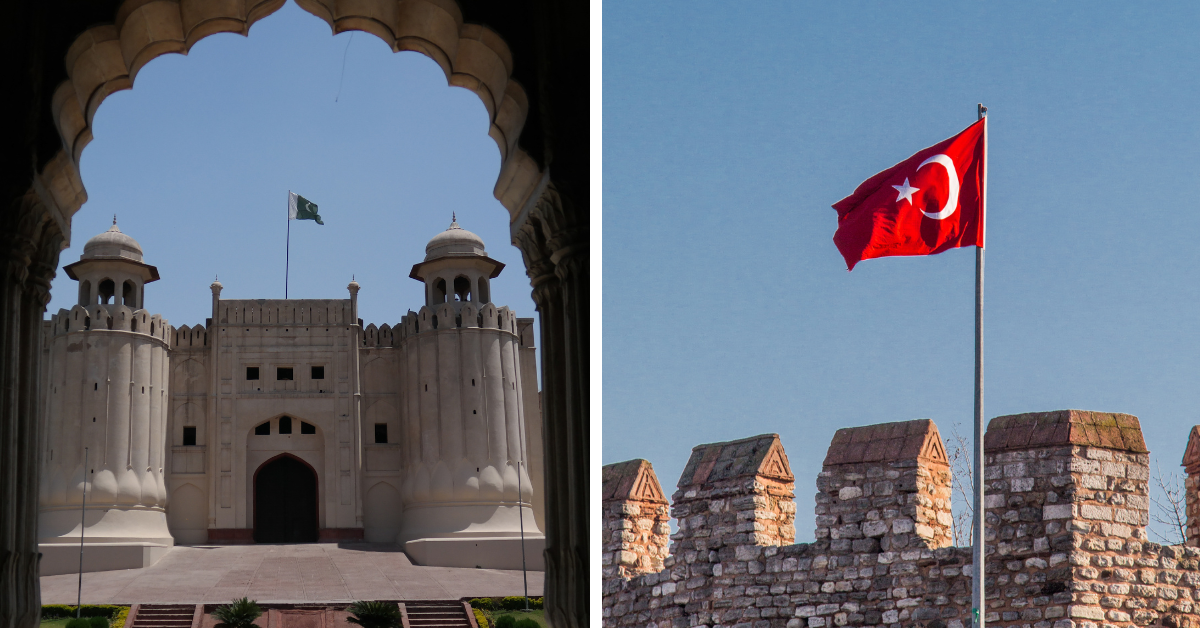
Pakistan and Turkey have been reliable friends. As the world changes for the worse, both will need each other — for the future, in the future, and alongside the future.
And what trials and tribulations lie for humanity in the foreseeable future is beyond the comprehension of the human mind, body, and soul today. So it seems.
Afrasiab Mehdi Hashmi Qureshi is a retired Pakistani diplomat and author with over three decades of experience in international relations. Having joined the Foreign Service in 1984, he served as Pakistan’s High Commissioner to Bangladesh and New Zealand, and as Additional Foreign Secretary for Asia-Pacific. He writes extensively on geopolitics and history, authoring several books including 1971 Fact and Fiction and Ancient and Contemporary Pakistan.